Published in the Fall 2026 edition of NCPERSPERSist.
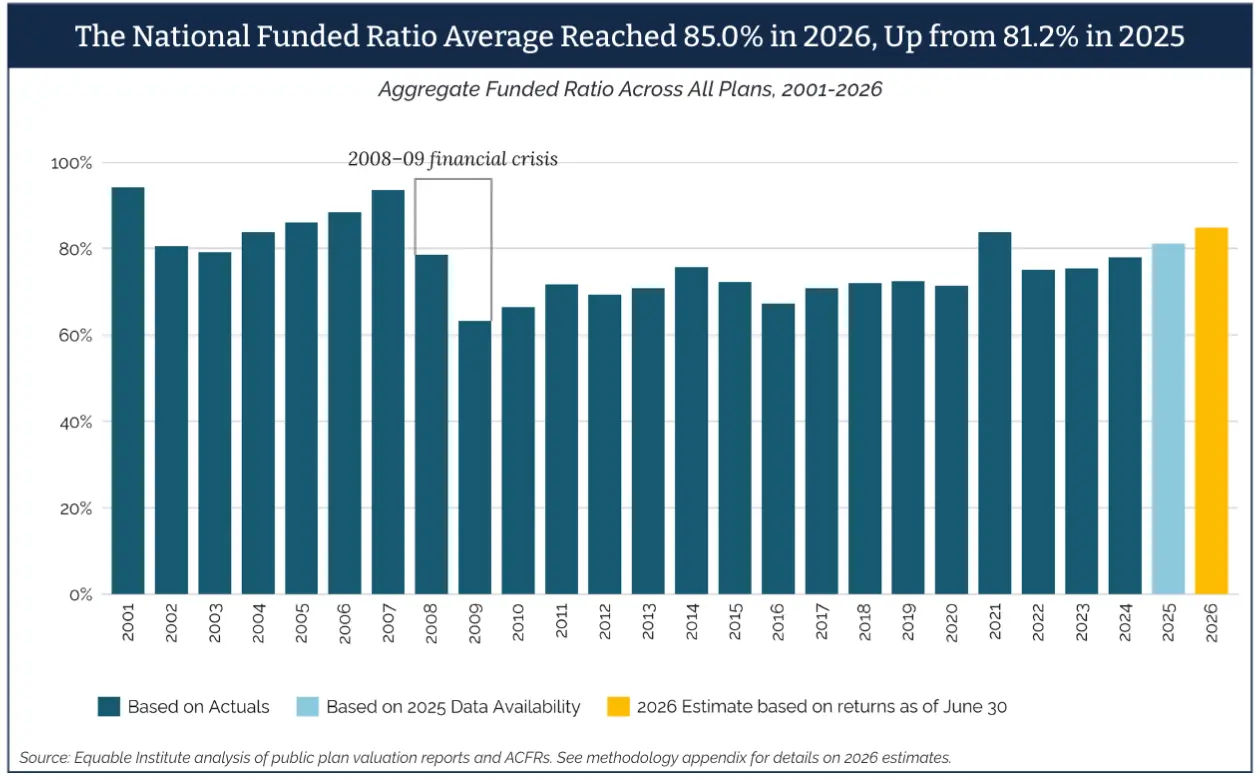
For public pension fiduciaries, meeting future retirement needs requires balancing two primary objectives: maintaining sufficient assets to meet benefits promised to participants and managing an investment portfolio capable of supporting those obligations over several decades. The average funded ratio for U.S. state and local pension plans is estimated at 85.0% in 2026, up from 81.2% in 2025 and representing a fourth consecutive year of improvement. At the same time, approximately $1.13 trillion in unfunded liabilities remains.¹
For trustees and investment committees, preserving that progress requires more than achieving a long-term return assumption. It also requires considering how portfolio volatility, liquidity, and the sources of investment returns can affect a plan’s ability to meet long-term obligations.
This raises an important fiduciary question: How can real estate credit help pension plans manage volatility in their funded status while preparing for long-term retirement liabilities?
Funded Status and the Importance of the Return Path
A pension plan’s funded ratio compares the assets accumulated to pay benefits with the actuarial value of its liabilities. Investment performance affects the asset side of that equation, meaning significant market losses can negatively affect funded status even as benefit obligations continue.
The mathematics of losses makes downside risk particularly relevant. A portfolio that declines 20% must subsequently gain 25% simply to return to its original value. For a mature pension simultaneously paying benefits, the path of investment returns can therefore matter alongside the long-term average return.
For fiduciaries, this suggests looking beyond expected return and asking: What risks and sources of return are being introduced to achieve it?
Where Real Estate Credit Can Fit
Real estate credit offers a return profile that differs from owning real estate equity. Rather than relying primarily on property appreciation, lenders generally seek to generate returns through contractual interest and fees. The lender’s position in the capital structure may also provide a buffer against property-value declines before principal is impaired.
Consider a simplified example. A $100 million property financed with a $65 million senior mortgage has $35 million of equity beneath the lender. If the property’s value declines 20% to $80 million, the lender’s $65 million principal remains covered by the property’s value, while the property’s equity has declined substantially.
This does not make the loan immune from loss. Property cash flow can deteriorate, borrowers can default, valuations can decline further and recoveries can fall below principal. However, appropriately structured loans with conservative attachment points may provide a different downside profile than equity ownership.
Within a broader pension portfolio, that distinction can be meaningful. Contractual income may reduce dependence on asset appreciation as a source of return, while lender seniority and collateral can provide additional protection during periods of property-level volatility.
The Fiduciary Question Goes Beyond Yield
For pension fiduciaries, however, an attractive contractual yield is not enough.
Trustees and investment committees should consider whether underlying property cash flow can support debt service; whether loan-to-value, sponsor capitalization and structural protections provide sufficient downside protection; and whether the expected return adequately compensates the plan for credit, valuation and liquidity risk.
Liquidity deserves particular attention. Private real estate loans generally cannot be traded as readily as public securities, and their duration and cash flows may not correspond directly with pension liabilities. Recent NCPERS fiduciary guidance on alternative investments similarly emphasizes evaluating performance, fees, liquidity, valuation, appropriate benchmarks, and investment complexity as part of a rigorous decision-making process.²
Real estate credit therefore should not be viewed as a substitute for traditional liability-matching assets. Instead, fiduciaries can evaluate whether its contractual income, downside characteristics and differentiated return drivers complement the plan’s broader asset-liability framework.
Supporting the Long-Term Promise
No individual asset class can solve the challenge of pension funding. Contributions, benefit payments, investment performance, actuarial assumptions and changes in liabilities all influence funded status.
For pension fiduciaries, the relevant question is therefore not simply whether real estate credit can generate an attractive return. It is whether the strategy’s income, downside protection, liquidity, and underlying risks fit within the total portfolio in a way that supports funded-status resilience and the plan’s long-term obligations to beneficiaries.
Ultimately, retirement security depends not only on generating returns, but on constructing a portfolio capable of sustaining the pension promise across market cycles.
About the Author
Daniel Savage serves as Senior Vice President, Investments & Strategy, at Peachtree Group, a private equity investment management firm based in Atlanta, Georgia. He oversees Peachtree’s Institutional Capital Markets roles and responsibilities, including investment product structuring, capital formation strategy, and the management of relationships with investment consultants and other institutional stakeholders.
Daniel earned a Bachelor of Science in Finance, with a specialization in Financial Risk Management, from Virginia Tech and completed additional coursework at the London School of Economics and Political Science.
Endnotes
Equable Institute, State of Pensions 2026, July 23, 2026.
Anya Freedman, “Six Questions for Fiduciaries Navigating Regulatory Change and Alternative Investment Uncertainty,” National Conference on Public Employee Retirement Systems, May 5, 2026.
Related posts
If you enjoyed this article, read through these related press releases and insights.