


EB-5 Bridge Financing Under Threat: Proposed DHS Rule
DHS's proposed July 2026 EB-5 rule could reshape bridge financing. Learn what leading immigration attorneys say, key changes, and what investors should know.


Each month the US State Department publishes the official Visa Bulletin, which is the source for information on visa availability in the United States. It shows which approved immigrant applicants may move forward to obtain their immigrant visa based on the date the original petition was filed. If your EB-5 petition is approved by USCIS, you go to the Visa Bulletin chart to see if there is a visa currently available for you.
The September 2026 Visa Bulletin keeps EB-5 Unreserved Final Action Dates current for most countries. For China-mainland born applicants, the Final Action Date remains December 1, 2016. For India, the category remains Unavailable (“U”), meaning no EB-5 Unreserved immigrant visa numbers are currently available for India-chargeable applicants during the remainder of FY2026, regardless of priority date.
The Department of State has confirmed that India reached its FY2026 pro-rated limit for EB-5 Unreserved visas. The new fiscal year begins October 1, 2026, at which point visa numbers become available again, although the applicable Final Action Date will depend on demand and the FY2027 visa allocation.
The Dates for Filing chart presents a different picture. It lists March 1, 2017 for China and May 1, 2024 for India. An India-born investor seeing May 1, 2024 should not interpret that date to mean immigrant visas are currently available. The Dates for Filing chart generally determines when applicants may begin the immigrant-visa documentation process and, when USCIS authorizes use of that chart, when certain applicants in the United States may file Form I-485. Final approval or immigrant visa issuance still depends on visa availability under the Final Action Date chart.
EB-5 Unreserved represents the 68% of annual EB-5 visa numbers not specifically reserved for the RIA set-aside categories. The September Visa Bulletin identifies the Unreserved classifications as C5, T5, I5, R5, NU and RU.
The Reserved or Set-Aside categories—Rural, High Unemployment Area, and Infrastructure—remain Current for every listed country, including China and India. Under the EB-5 Reform and Integrity Act, 20% of annual EB-5 visas are reserved for Rural investments, 10% for High Unemployment Area investments, and 2% for Infrastructure investments.
Importantly, the current availability of the Reserved categories reflects the separate statutory allocation and demand for those visa numbers. Unused Reserved visa numbers are subject to specific carryover provisions under the RIA and may ultimately become available to the Unreserved category in later fiscal years.
Read below for more on how to read the Visa Bulletin.
There are 140,000 employment-based green cards available each year, with specific limits for each "preference" category. US immigration law also sets limits on the number of green cards available based on the country of origin. No single country of origin can account for more than 7% of the green cards issued across all family-based and employment-based categories.
Although generally not an issue for most countries, this country-of-origin cap can create backlogs for EB-5 investors from China and India. (Generally, there are not enough EB-5 applicants from Mexico or the Philippines to create backlogs for those countries, which are the only other countries subject to the country-of-origin caps.)
The State Department has already moved India's EB-5 unreserved final action date to "Unavailable" for September, citing sufficient demand and increased number use by aliens chargeable to India in that category. The Bulletin also warns that the EB-5 Unreserved category more broadly could see further retrogression, or become unavailable for other countries as well, before the fiscal year ends on September 30, 2026, if demand continues to outpace the maximum allowed under the FY 2026 annual limit. This situation will be continually monitored, and any necessary adjustments will be made accordingly.
Potential EB-5 participants should refer to the Visa Bulletin to understand whether there are visas immediately available for them after their I-526 or I-526E petition is approved.
The chart for EB-5 from the latest visa bulletin shows the following:
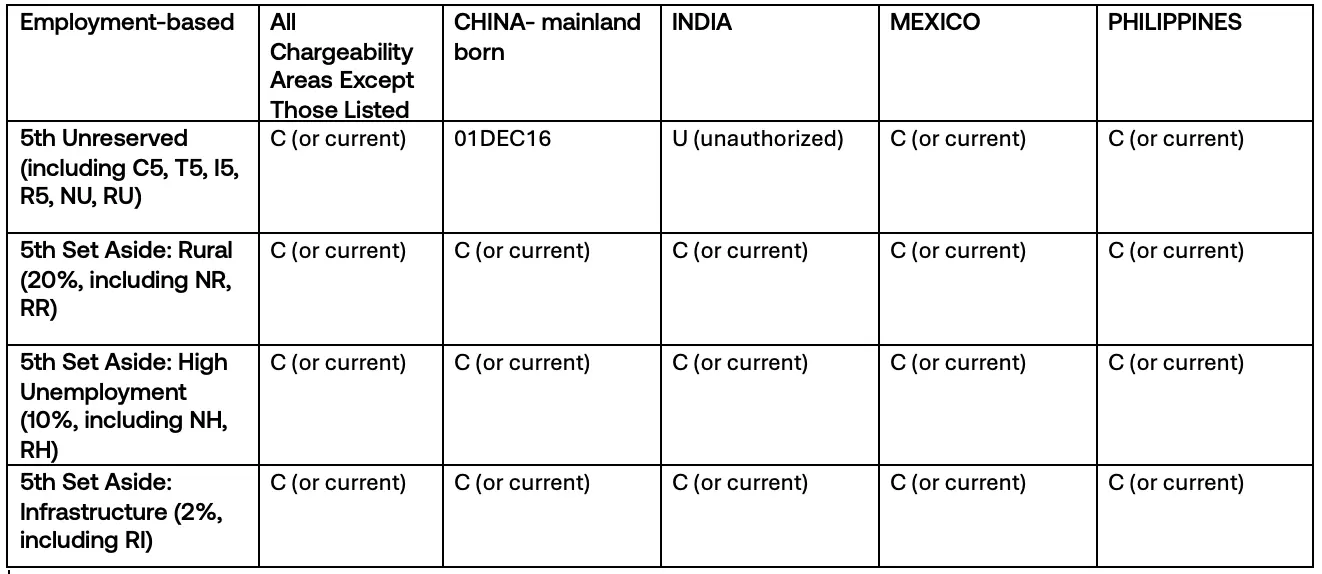
This Visa Bulletin shows there is currently a backlog only for investors approved under the "old" EB-5 program, which was in place before the EB-5 Reform and Integrity Act of 2022 (the "RIA"), effective on March 15, 2022.
For Chinese investors, the date is December 1, 2016. Investors from China who applied under the old program after the cutoff dates listed cannot immediately seek to get their visa and move to the United States. They must wait for the listed date to move forward to their petition's application date, generally known as their "priority date".
For Indian investors, the unreserved final action date is not a date at all anymore, but "Unavailable." That means no numbers are currently being issued to India-born unreserved EB-5 applicants, no matter how early their priority date is. Investors from India should not confuse this with the Dates for Filing chart, which shows May 1, 2024. That chart only controls when documents may be submitted, not when a visa can be issued.
Note it is only the "Unreserved" preference category in EB-5 that shows a cutoff date or unavailability. The new reserved preference categories for EB-5 all show as 'C' or "Current", meaning anyone who has an approved EB-5 petition related to the new reserved visas created by the RIA can start the process to immigrate to the US, even those from China and India.
Think of the Visa Bulletin like a toll plaza on a highway. It lists how long the line is at the toll booth and separates the line for specific countries that have a backlog. However, the Visa Bulletin does not show how many cars are on the highway on their way to the toll plaza. Those are the pending petitions. This information is generally not made public, but there have been efforts by EB-5 industry groups to get this information.
Concurrent filing is a mechanism where EB-5 investors already in the United States can send in some forms at the same time as their first Form I-526E application, instead of waiting until that application is approved. With concurrent filing, investors can fill out and send in both their Form I-485 (Application to Register Permanent Residence or Adjust Status) and their Form I-526E petition at the same time.
Generally, this will allow those investors to:
In our metaphor, this means that it does not matter how many cars are on the highway ahead of you. As long as there is not yet a line at the toll booth, you may apply for these benefits. Essentially, if you're here, you can stay here.
Have questions about EB-5? Visit our website or fill out our contact form.