Inside the Advisor's Playbook: Portfolio Strategy with Jen DeSisto
Comparte este post
Listen on Spotify!
Listen on Apple Podcasts!
The investment landscape is shifting in real time. With wealth moving to younger generations and public markets growing more concentrated, investors are confronting a central challenge: how do you build true diversification when the old playbook no longer fits?
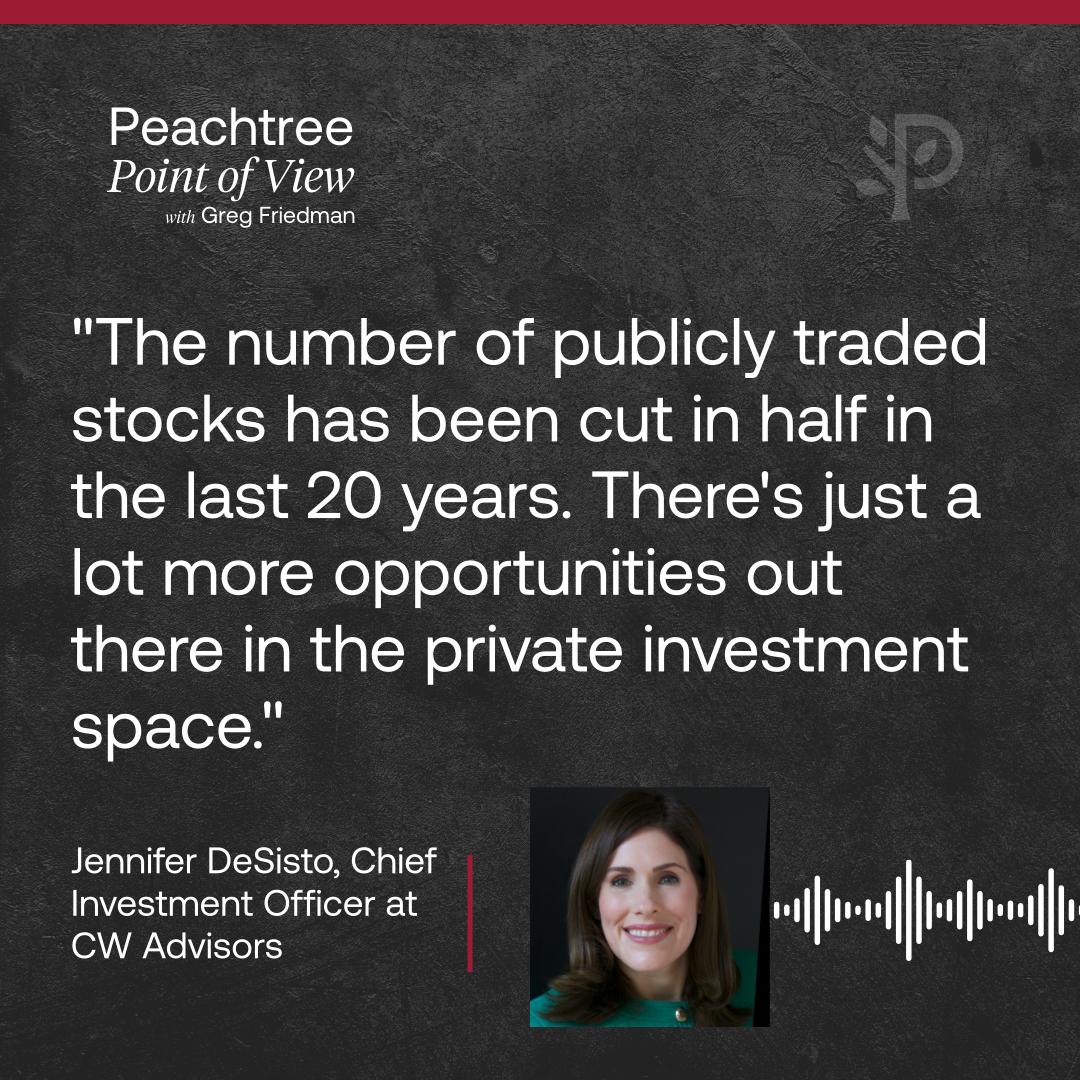
Here is a statistic that should get your attention: “The number of publicly traded stocks has been cut in half in the last 20 years,” DeSisto notes. At the same time, the S&P 500 has grown more concentrated in a small group of technology companies, with the Magnificent 7 driving much of the recent performance.
So what does this mean for your portfolio? If you lean heavily on traditional public markets, your exposure is likely more concentrated than your allocation suggests. You are also investing in a shrinking set of public companies at a time when private companies and private market opportunities have expanded.
Your Investor Profile Matters
The right allocation to alternative investments is never one size fits all. It depends on your liquidity needs, tax profile, portfolio size and risk tolerance. For accredited investors exploring alternatives for the first time, DeSisto suggests beginning with 5 to 10 percent in private investments. “We try to leg into some of these private investments,” she explains. “We have tried to build a diversified mix that offers semi-liquid features or income distributions.”
For qualified purchasers with larger portfolios and more flexibility, the allocation shifts. “We recommend 30 to 40 percent in private investments,” DeSisto says. This typically includes private equity and venture at 12 to 15%, private credit at 12 to 15% and direct real estate and infrastructure at 5 to 6% each.
Understanding What Your Capital is Funding
Most investors respond to projects they can see and understand. Real estate developments they can visit. Infrastructure that supports data centers. “Individual things like that get clients excited and they are fun to talk about with people,” DeSisto says. That kind of tangibility matters because when you can picture what your capital is funding, it changes how you view the investment.
The Case for Private Credit
For investors new to alternatives, DeSisto leans toward structures that offer regular income or some degree of liquidity. In private credit, she prefers evergreen vehicles where “you have monthly income coming in, loans are maturing, they are being replaced.”
And while recent headlines have raised concerns about defaults, she stays grounded in the data. “Defaults are a normal part of making loans,” she says. “In any given year, you are going to have 2 to 3% default rates in the debt markets.” The high-profile issues making news were tied to syndicated loans at traditional banks rather than private debt funds.
Looking ahead to 2026, both DeSisto and Friedman expect a stronger environment for investors. “I think 2026 is going to be a much better year for distributions back to investors,” Friedman says, pointing to stabilizing rates and improving M&A activity.
Key Takeaways:
Check Your Concentration: With public stocks down 50% over 20 years and the S&P 500 dominated by a handful of companies, your portfolio may be more concentrated than you realize.
Scale Appropriately: Consider 5-10% allocation if you're an accredited investor new to alternatives; 30-40% if you're a qualified purchaser seeking comprehensive diversification.
Structure Matters: Look for investments with structures that match both the underlying assets and your liquidity needs, favoring vehicles with regular distributions or semi-liquid features when starting out.
Ready to explore how alternative investments fit into your portfolio strategy? Listen to the full Peachtree Point of View podcast episode for deeper insights on modern portfolio construction.
Relacionado publicaciones
Si te ha gustado este artículo, lee estos comunicados de prensa y puntos de vista relacionados.