


Opportunity Zones 2.0: What Investors Need to Know About 2027 Changes
What investors should know about Opportunity Zones 2.0, including how the program works, its potential tax benefits and key investment considerations.


Opportunity Zones are entering their second phase. Starting in 2027, the program becomes permanent, capital gains get a rolling five-year deferral instead of a fixed deadline, and rural investments qualify for a larger basis step-up. Zones will also be redesignated every 10 years going forward. These changes make Opportunity Zones easier to fold into long-term investment planning, but they don't change the importance of underwriting the investment itself.
Opportunity Zones will look materially different beginning in 2027. The key changes are summarized below.
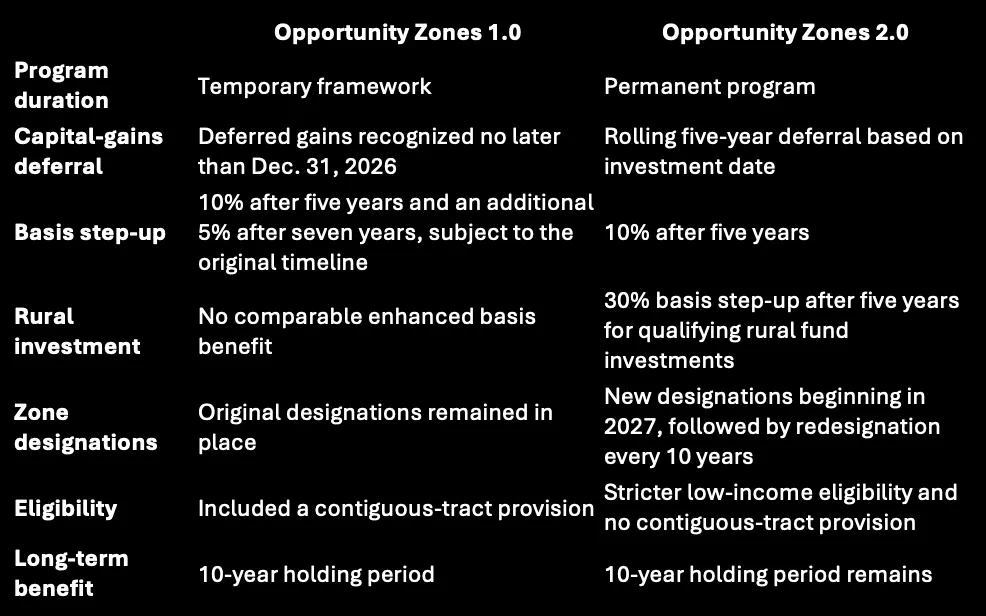
The first new round of Opportunity Zone designations takes effect January 1, 2027, beginning a recurring 10-year redesignation cycle. For investors evaluating Opportunity Zones ahead of 2027, five questions stand out.
OZ 2.0 replaces the program-wide 2026 recognition deadline with a five-year deferral period for qualifying investments made beginning in 2027. Deferred gains are generally recognized five years after the investment, unless an earlier inclusion event occurs.
Under OZ 1.0, deferred gains generally had to be recognized by December 31, 2026, regardless of when the investment was made, making the benefit progressively less valuable as the deadline approached.
Under OZ 2.0, each qualifying investment effectively receives its own five-year clock. Will Woodworth, senior vice president of investments at Peachtree Group, expects the change to allow better tax planning and support “more consistent cash flows into the space.”
Investors who hold a qualifying OZ 2.0 investment for at least five years receive a 10% basis step-up, while investments in a Qualified Rural Opportunity Fund (QROF) receive a 30% step-up after five years.
Under OZ 1.0, investors could receive a 10% increase after five years and another 5% after seven years, although the program’s fixed timeline limited those benefits for later investments.
OZ 2.0 also reduces the substantial-improvement threshold for property located entirely within qualifying rural Opportunity Zones from 100% to 50%. These incentives could make some rural projects more viable, but investors still need to independently underwrite demand, liquidity, financing and exit risk.
Yes. OZ 2.0 makes Opportunity Zones a permanent part of the tax code, with qualifying areas refreshed every 10 years.
Under OZ 1.0, investors faced an eventual program expiration and a fixed 2026 recognition date. Permanence allows investors, developers and capital allocators to evaluate Opportunity Zones as a long-term investment framework rather than an incentive approaching expiration.
As Woodworth put it, permanence makes Opportunity Zones an actionable strategy “not just right now, but for decades into the future.”
Yes. Under OZ 2.0, Opportunity Zones will be redesignated every 10 years, with the first new round taking effect in 2027. That differs from OZ 1.0, where the original map was essentially static.
Eligibility also becomes more targeted, with the qualifying median-family-income threshold declining from 80% to 70% and the contiguous-tract provision eliminated.
As a result, markets that qualified under OZ 1.0 may not qualify under OZ 2.0, while new eligible areas will emerge.
No. Investors generally still need to hold a qualifying Opportunity Zone investment for at least 10 years to access the program’s principal long-term tax benefit.
That remains an important consideration for real estate investors because a decade can span multiple property and credit cycles. Financing, valuations, supply and demand, and liquidity may look very different at exit than at acquisition.
The improved tax framework therefore does not change the importance of investment fundamentals, including basis, leverage, refinancing assumptions and sponsor execution.
OZ 2.0 also introduces a new 30-year rule worth noting. Under OZ 1.0, an investor only received the step-up to fair market value by selling the investment after the 10-year mark. Under OZ 2.0, that step-up to fair market value happens automatically at the 30-year point, regardless of whether the investor has sold.
Investors should first ask whether the underlying investment is attractive without the Opportunity Zone tax benefits.
The 2027 relaunch makes Opportunity Zones easier to evaluate as part of ongoing capital allocation rather than as a deadline-driven tax strategy. But the fundamental question remains:
Would this be an attractive investment without the tax benefit?
If the answer is no, a better Opportunity Zone structure may not change it. If the real estate, basis and capital structure are compelling, however, OZ 2.0 provides a more predictable framework for evaluating the after-tax return across multiple investment and real estate cycles.
This article is for informational purposes only and does not constitute tax, legal or investment advice.