



Barron’s: The surprising case for investing in real estate now
Peachtree Group CEO Greg Friedman sees opportunities in hotel development and real estate debt, citing strong travel demand, limited new hotel supply and attractive loan yields.


A Roth IRA conversion strategy involves moving assets from a traditional IRA into a Roth IRA. The value converted is generally treated as taxable income in the year of conversion, while qualified distributions from the Roth IRA can generally be taken tax-free in retirement.
For investors holding commercial real estate development investments in a traditional IRA, the timing of the conversion can introduce another consideration: valuation.
In a recent episode of Peachtree Point of View, Greg Friedman, CEO of Peachtree Group, joined Tim Witt, president of Peachtree Group’s DST Program, and Victor LeBlanc, managing director and external wholesaler, to discuss how Roth conversions can intersect with commercial real estate development.
Traditional and Roth IRAs differ primarily in when taxes are paid.
With a traditional IRA, taxes on eligible assets are generally deferred until distributions are taken. With a Roth IRA, taxes are paid before assets enter the Roth structure, and qualified distributions can generally be taken tax-free.
A Roth conversion moves existing traditional IRA assets into a Roth IRA. The amount converted generally becomes taxable income for that year.
That makes the value of an asset at the time of conversion particularly important when the IRA holds an alternative investment whose value can change over time.
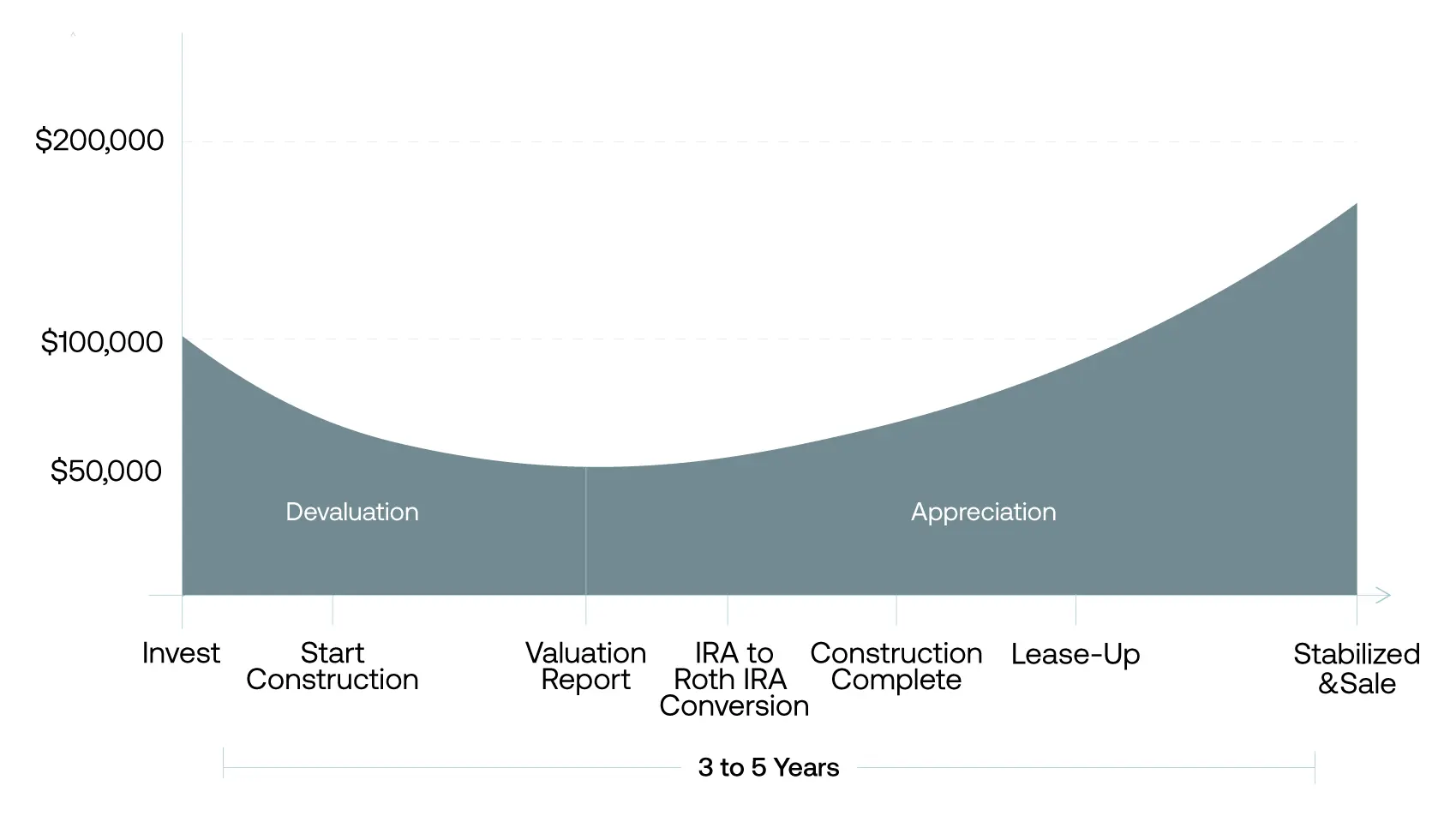
Commercial real estate development often follows what Tim Witt describes as a J-curve.
After an investor contributes capital, that money is gradually deployed into expenses such as:
During this period, much of the original cash may have been spent while the property remains incomplete.
An unfinished development can have fewer potential buyers than a stabilized property. An ownership interest in an LLC or limited partnership may also be affected by factors such as illiquidity and lack of control.
Together, those factors may result in an independently appraised value below the investor’s original contribution.
Consider the simplified example discussed in the podcast.
An investor places $100,000 of traditional IRA assets into a development investment. During construction, an independent appraisal values that interest at $60,000 or $70,000.
If the investor converts the investment to a Roth IRA at that point, the taxable conversion may be based on the lower independently determined value.
The strategy does not eliminate the conversion tax. Instead, it potentially changes the value on which the conversion tax is calculated.
If the project is subsequently completed, stabilized and appreciates, that potential future value creation would occur after the investment has moved into the Roth structure.
Independent valuation is central to the process described by Witt.
Peachtree does not internally select the lower value used for a conversion. Instead, an independent third-party appraiser evaluates the investment and determines an updated value.
The appraisal may consider factors including:
The purpose is to establish a defensible assessment of the investment’s value at that stage of development rather than apply an arbitrary discount.
1. A Roth conversion is primarily a question of tax timing.
You generally recognize taxable income when traditional IRA assets are converted, in exchange for moving those assets into a structure where qualified future distributions can generally be tax-free.
2. Development can create a distinct valuation window.
An incomplete and illiquid development investment may temporarily appraise below its original value, potentially affecting the amount subject to conversion tax.
3. The investment still has to work on its own merits.
A lower appraisal does not make an unsuccessful project successful. Financing, construction execution, market demand, diversification and potential value creation remain essential investment considerations.
A Roth conversion involving commercial real estate brings together tax planning, valuation and investment risk. Any conversion decision should be considered in the context of an investor’s individual circumstances and reviewed with a qualified CPA or tax adviser.
Listen to the full episode of Peachtree Point of View to hear Greg Friedman, Tim Witt and Victor LeBlanc discuss Roth IRA conversions, development valuations, diversification and the investment considerations behind the strategy.