





How Higher Interest Rates Impact CRE Refinancing and Private Credit
Higher interest rates are making commercial real estate refinancing more difficult by increasing debt costs and reducing borrowing capacity. For investors, these financing gaps are creating opportunities in private credit, loan acquisitions and recapitalizations, even when the underlying properties remain financially sound properies.
On Peachtree Point of View, Greg Friedman, Managing Principal & CEO of Peachtree Group, discussed these pressures and emerging investment opportunities with Michael Ritz, EVP, Investments, and Daniel Siegel, President and Principal, CRE.
Why Are Commercial Real Estate Loan Maturities Important?
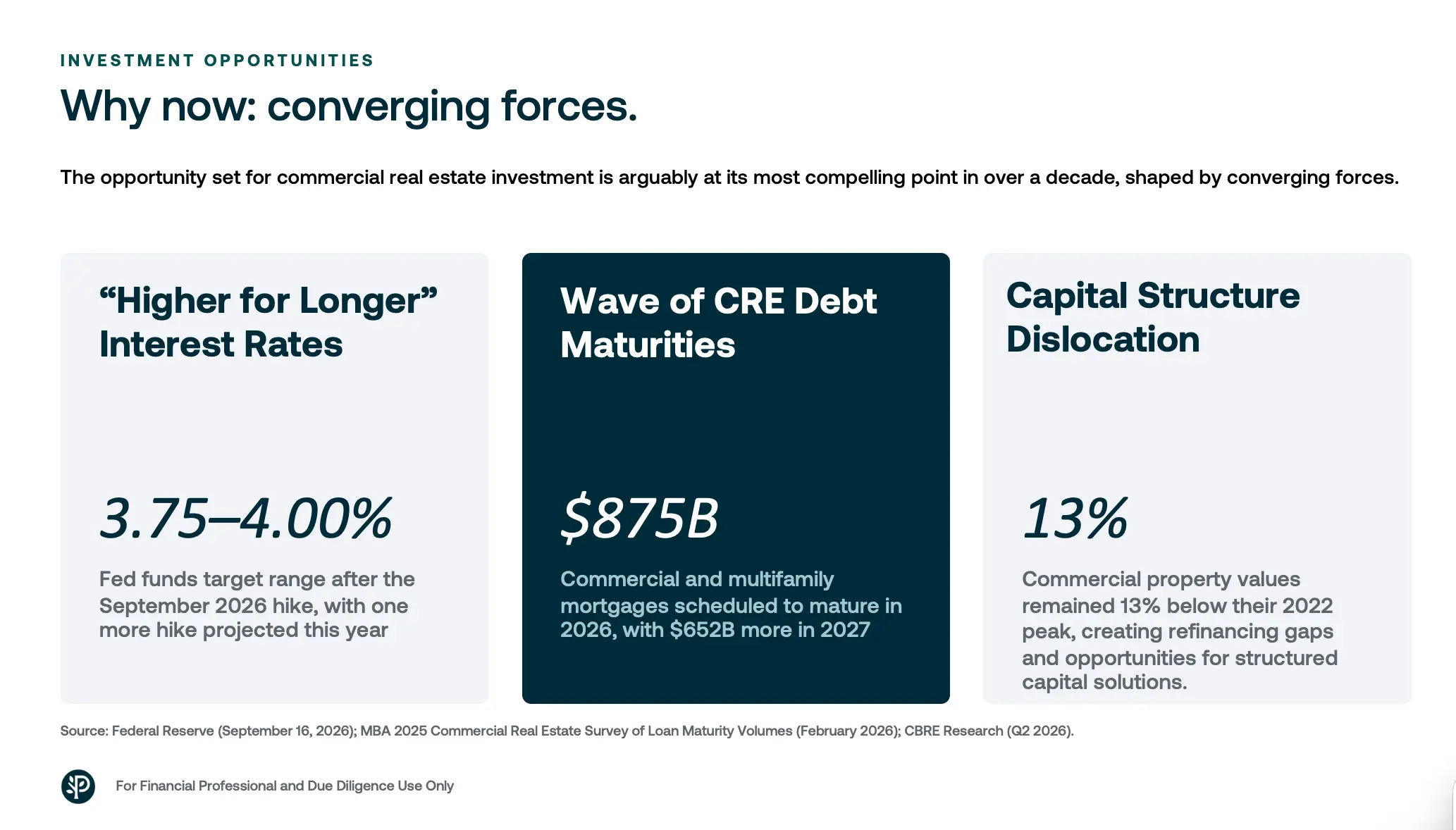
According to Mortgage Bankers Association figures cited in the episode, approximately $875 billion in commercial and multifamily mortgages are scheduled to mature in 2026, with another $652 billion in 2027.
Many commercial real estate loans were originated when borrowing costs were significantly lower. Refinancing those loans today often requires borrowers to contribute additional equity, accept smaller loan proceeds or seek alternative financing solutions.
Siegel explains that borrowers who have already extended their loans now face difficult decisions about which properties warrant additional investment. Yet the underlying assets may continue to perform well. As Siegel observes, "the actual patronage or utility of these assets themselves isn't really the problem here."

What Do Refinancing Challenges Mean for Borrowers and Investors?
Higher financing costs are forcing borrowers to contribute additional equity, restructure existing debt or seek alternative sources of capital. For investors, these challenges are creating opportunities to provide financing where traditional lenders are unable or unwilling to participate.
Private credit investors may benefit from more attractive pricing, stronger lender protections and favorable positions in the capital structure. Loan acquisitions and recapitalizations also present opportunities to invest in fundamentally sound properties facing financial rather than operational challenges.
The key is distinguishing capital structure dislocation from underlying asset weakness and identifying opportunities where disciplined underwriting and flexible financing can generate attractive risk-adjusted returns.
How Do Higher Rates Reduce Refinancing Capacity?
Lenders commonly assess two measures:
- Loan-to-value ratio (LTV): Debt divided by property value. A decline in value increases the ratio if debt remains unchanged.
- Debt-service coverage ratio (DSCR): Net operating income divided by debt payments. Higher interest expense can weaken coverage.
A property can therefore remain occupied and cash-flowing yet be unable to refinance its existing debt on comparable terms.
Ritz emphasizes the need to separate property fundamentals from financing conditions. The source of stress matters when assessing risk.
Who Is Lending to Commercial Real Estate?
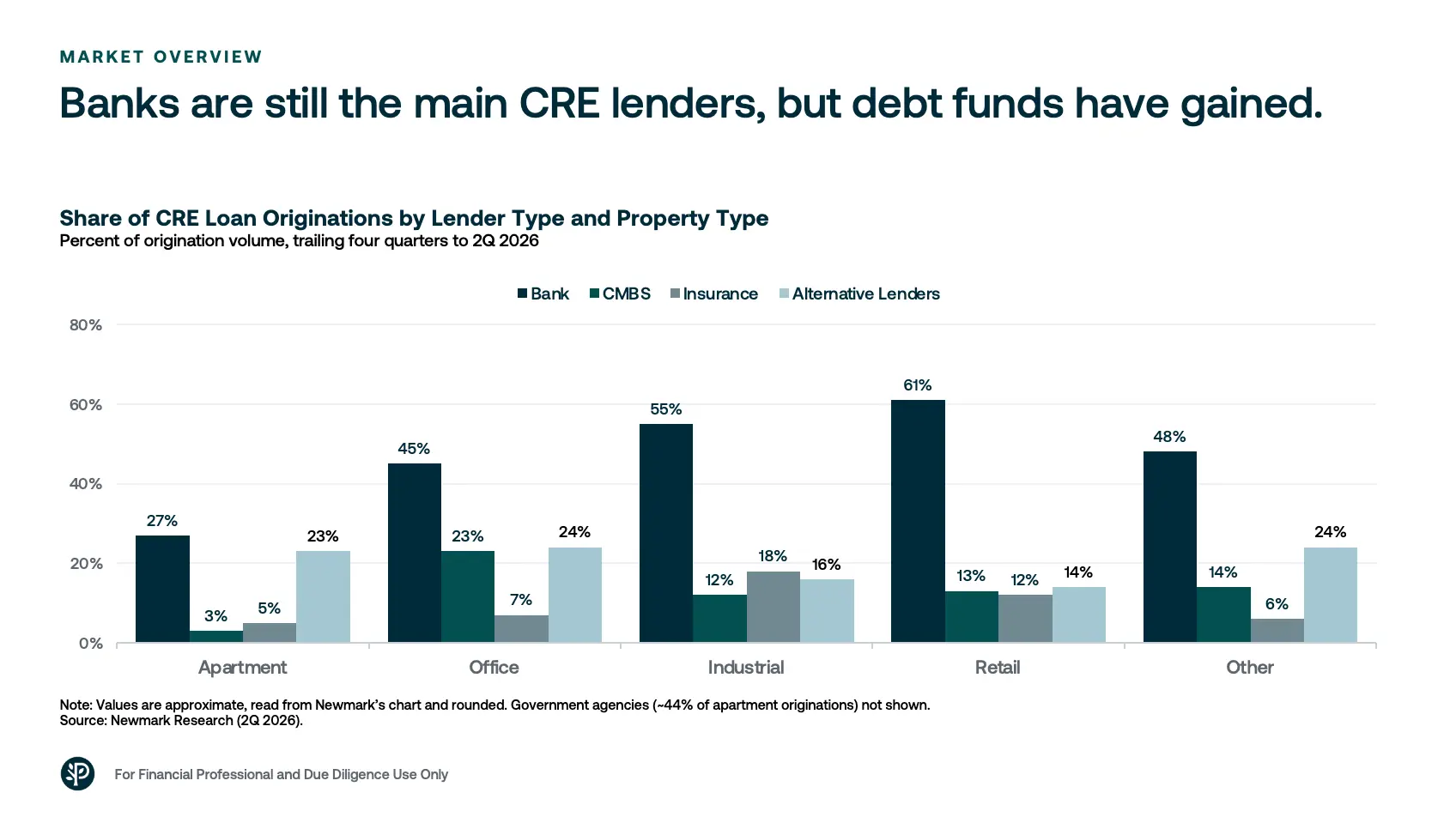
Banks remain important lenders, but their participation varies by property type.
Newmark data presented in the episode shows banks accounting for approximately 61% of retail, 55% of industrial and 45% of office originations within the chart's categories for the trailing four quarters through Q2 2026.
That variation matters because financing availability depends on the asset, borrower and lender's risk appetite.

Why Is Private Credit Gaining Ground?
As banks face tighter regulatory requirements, balance sheet constraints and greater scrutiny of commercial real estate exposure, private credit providers are playing an increasingly important role in financing transactions. These non-bank lenders can offer flexible capital solutions, including bridge loans, refinancings, loan acquisitions and structured financing.
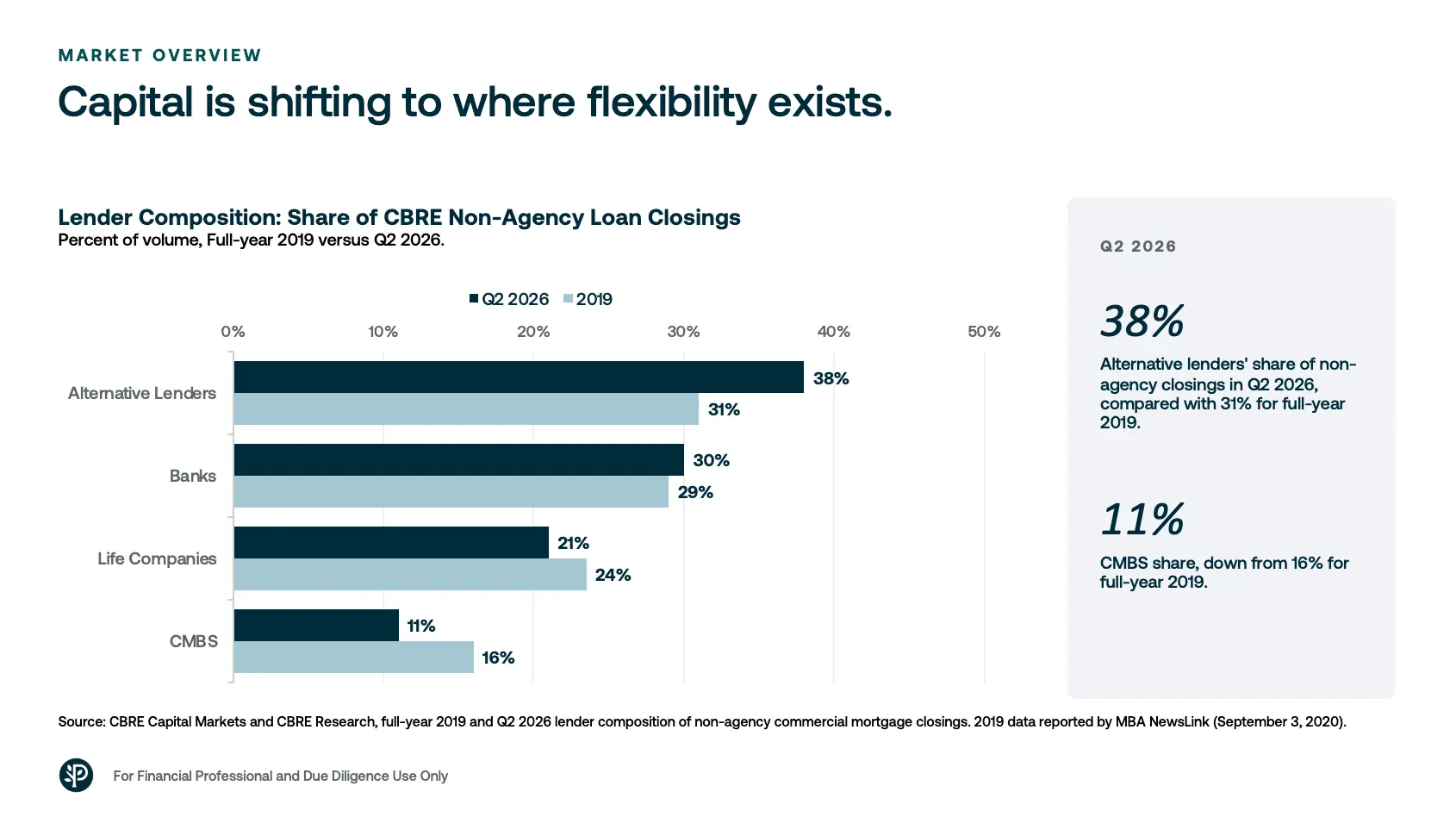
The shift is reflected in lending activity. According to CBRE data presented by Peachtree, alternative lenders accounted for 38% of non-agency commercial mortgage closings in the second quarter of 2026, compared with 31% for full-year 2019.
For borrowers, this expanding pool of alternative capital provides additional financing options when traditional lenders are constrained. For investors, it creates opportunities to deploy capital into transactions where financing demand remains strong but conventional lending capacity is limited.

Friedman sees opportunities in bridge financing, loan acquisitions, preferred equity and recapitalizations as borrowers navigate capital structure challenges and more restrictive lending conditions. However, realizing attractive risk-adjusted returns requires disciplined underwriting, with particular attention to collateral quality, borrower strength, financing structure and execution risk.
Three Key Takeaways
1. Maturing loans are creating refinancing pressure even for viable properties.
2. Capital availability differs by property type and lender.
3. Private credit can help address financing gaps, but careful underwriting remains essential.
Frequently Asked Questions
What is a commercial real estate refinancing gap?
It is the difference between the amount needed to repay an existing loan and the proceeds available from a new one.
Why can a healthy property struggle to refinance?
Higher interest costs and lower valuations may reduce its borrowing capacity despite stable occupancy or income.
Why would a bank sell a performing or adequately secured loan?
Capital requirements, portfolio limits or other institutional constraints can motivate sales independent of the collateral's condition.
Does private credit eliminate refinancing risk?
No. Private credit offers alternative financing structures, but repayment, collateral and execution risks remain.


2026 YTD: $2.2B Private Credit, $524M Government-Enabled Financing
Lodging Magazine- Peachtree Group announced that it has completed approximately $2.2 billion in private credit activity year-to-date in 2026, including approximately $524 million in government-enabled financing through Small Business Administration (“SBA”) 7(a) and Commercial Property Assessed Clean Energy (“C-PACE”) transactions.
Peachtree’s government-enabled financing capabilities include SBA 7(a) loans originated through First Western SBLC, C-PACE financing enabled through applicable state and local programs, and USDA B&I-guaranteed financing for eligible rural businesses and real estate projects.
Statements From Leadership
“Borrowers are navigating a market in which the right capital is not always available through a single conventional lending channel,” said Greg Friedman, managing principal and chief executive officer of Peachtree Group. “Our objective is to bring the appropriate tools to each transaction, whether institutional private credit, SBA financing, C-PACE, USDA B&I or a combination of those solutions, so capital can be structured around the opportunity.”
“Each program addresses a distinct capital need, but the value of our platform is the ability to consider them together,” said Jared Schlosser, head of originations and C-PACE at Peachtree Group. “We have already demonstrated that by layering C-PACE with USDA B&I financing, allowing us to address different needs within the same transaction. That flexibility gives us more ways to structure capital around the asset, the borrower and the business plan.”
“There is a significant part of the hotel market where owners need financing that does not fit neatly into a conventional lending box,” said Brent LeBlanc, executive vice president of business development at Peachtree Group. “Having multiple financing capabilities allows us to serve borrowers at different stages, from entrepreneurs acquiring their first hotel to experienced owners expanding their portfolios and institutional sponsors executing much larger transactions.”
.webp)
Opportunity Zones 2.0: What Investors Need to Know About 2027 Changes
Executive Summary
Opportunity Zones are entering their second phase. Starting in 2027, the program becomes permanent, capital gains get a rolling five-year deferral instead of a fixed deadline, and rural investments qualify for a larger basis step-up. Zones will also be redesignated every 10 years going forward. These changes make Opportunity Zones easier to fold into long-term investment planning, but they don't change the importance of underwriting the investment itself.
Opportunity Zones 1.0 vs. 2.0
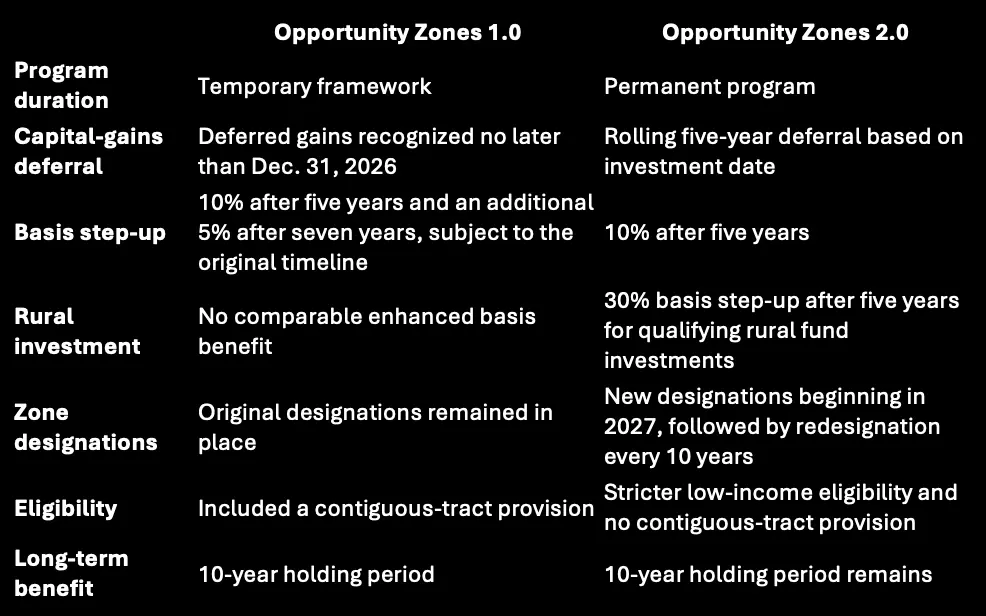
Opportunity Zones will look materially different beginning in 2027. The key changes are summarized below.

The first new round of Opportunity Zone designations takes effect January 1, 2027, beginning a recurring 10-year redesignation cycle. For investors evaluating Opportunity Zones ahead of 2027, five questions stand out.
How Does Tax Deferral Change Under OZ 2.0?
OZ 2.0 replaces the program-wide 2026 recognition deadline with a five-year deferral period for qualifying investments made beginning in 2027. Deferred gains are generally recognized five years after the investment, unless an earlier inclusion event occurs.
Under OZ 1.0, deferred gains generally had to be recognized by December 31, 2026, regardless of when the investment was made, making the benefit progressively less valuable as the deadline approached.
Under OZ 2.0, each qualifying investment effectively receives its own five-year clock. Will Woodworth, senior vice president of investments at Peachtree Group, expects the change to allow better tax planning and support “more consistent cash flows into the space.”
What Basis Step-Up Do Investors Receive Under OZ 2.0?
Investors who hold a qualifying OZ 2.0 investment for at least five years receive a 10% basis step-up, while investments in a Qualified Rural Opportunity Fund (QROF) receive a 30% step-up after five years.
Under OZ 1.0, investors could receive a 10% increase after five years and another 5% after seven years, although the program’s fixed timeline limited those benefits for later investments.
OZ 2.0 also reduces the substantial-improvement threshold for property located entirely within qualifying rural Opportunity Zones from 100% to 50%. These incentives could make some rural projects more viable, but investors still need to independently underwrite demand, liquidity, financing and exit risk.
Will Opportunity Zones Be Permanent Under OZ 2.0?
Yes. OZ 2.0 makes Opportunity Zones a permanent part of the tax code, with qualifying areas refreshed every 10 years.
Under OZ 1.0, investors faced an eventual program expiration and a fixed 2026 recognition date. Permanence allows investors, developers and capital allocators to evaluate Opportunity Zones as a long-term investment framework rather than an incentive approaching expiration.
As Woodworth put it, permanence makes Opportunity Zones an actionable strategy “not just right now, but for decades into the future.”
Will the Opportunity Zone Map Change in 2027?
Yes. Under OZ 2.0, Opportunity Zones will be redesignated every 10 years, with the first new round taking effect in 2027. That differs from OZ 1.0, where the original map was essentially static.
Eligibility also becomes more targeted, with the qualifying median-family-income threshold declining from 80% to 70% and the contiguous-tract provision eliminated.
As a result, markets that qualified under OZ 1.0 may not qualify under OZ 2.0, while new eligible areas will emerge.
Does OZ 2.0 Change the 10-Year Holding Period?
No. Investors generally still need to hold a qualifying Opportunity Zone investment for at least 10 years to access the program’s principal long-term tax benefit.
That remains an important consideration for real estate investors because a decade can span multiple property and credit cycles. Financing, valuations, supply and demand, and liquidity may look very different at exit than at acquisition.
The improved tax framework therefore does not change the importance of investment fundamentals, including basis, leverage, refinancing assumptions and sponsor execution.
OZ 2.0 also introduces a new 30-year rule worth noting. Under OZ 1.0, an investor only received the step-up to fair market value by selling the investment after the 10-year mark. Under OZ 2.0, that step-up to fair market value happens automatically at the 30-year point, regardless of whether the investor has sold.
What Should Investors Consider Before Investing in OZ 2.0?
Investors should first ask whether the underlying investment is attractive without the Opportunity Zone tax benefits.
The 2027 relaunch makes Opportunity Zones easier to evaluate as part of ongoing capital allocation rather than as a deadline-driven tax strategy. But the fundamental question remains:
Would this be an attractive investment without the tax benefit?
If the answer is no, a better Opportunity Zone structure may not change it. If the real estate, basis and capital structure are compelling, however, OZ 2.0 provides a more predictable framework for evaluating the after-tax return across multiple investment and real estate cycles.
Watch Will Woodworth explain the key changes coming with Opportunity Zones 2.0 and what investors should know:
This article is for informational purposes only and does not constitute tax, legal or investment advice.

Peachtree Group Earns Fourth Consecutive Inc. 5000 Recognition
Peachtree Group, a vertically integrated private investment firm active in commercial real estate, private credit and hospitality, today announced it has been named to the 2026 Inc. 5000, marking the firm’s fourth consecutive year on the magazine’s annual ranking of the fastest-growing private companies in the United States. Peachtree ranked 3,831 on this year’s list, with three-year revenue growth of approximately 67%.
Sustaining that pace is rare. Research from Stanford Graduate School of Business and IESE Business School found that only about 30% of companies on high-growth rankings return the following year, implying that roughly 3% would be expected to appear four successive years.
For Peachtree, the growth behind the ranking has also meant a larger team and a wider set of career paths. The firm has grown to over 3,700 employees across its investment, lending, development and hospitality businesses, with approximately 10% of open roles filled internally over the past year.
“We’re grateful for the recognition, but what I’m most proud of is the ecosystem behind it,” said Greg Friedman, managing principal and CEO of Peachtree. “We’ve built a place where someone can start in one division and build an entire career here, moving from real estate into credit, from underwriting into hotel operations, from analyst to principal, without ever having to leave. Growth on a list is a byproduct. Advancement in people’s careers is the point, and it’s the reason we’ve been able to maintain our expansion through different market environments.”
The recognition follows another milestone for the firm. Earlier this year, Peachtree was named to the inaugural PERE Credit 100, ranking among the world’s leading commercial real estate private credit managers. The annual ranking measures firms based on institutional capital raised for private real estate credit strategies over the previous five years.
“Together, these recognitions tell a consistent story,” Friedman added. “The Inc. 5000 acknowledges our ability to scale a high-growth business over time, and the PERE Credit 100 reflects the institutional platform we’ve built in commercial real estate credit. Both recognitions reveal the same foundation, a team that has earned the confidence of our investors and our partners.”

