
Commercial Observer: Peachtree Refis Nashville Hotel With $63M Loan
Peachtree Group provided a $62.5M loan to refinance Graduate by Hilton Nashville, a 205-room hotel near Vanderbilt University in Nashville’s Midtown market.



A Roth IRA conversion strategy involves moving assets from a traditional IRA into a Roth IRA. The value converted is generally treated as taxable income in the year of conversion, while qualified distributions from the Roth IRA can generally be taken tax-free in retirement.
For investors holding commercial real estate development investments in a traditional IRA, the timing of the conversion can introduce another consideration: valuation.
In a recent episode of Peachtree Point of View, Greg Friedman, CEO of Peachtree Group, joined Tim Witt, president of Peachtree Group’s DST Program, and Victor LeBlanc, managing director and external wholesaler, to discuss how Roth conversions can intersect with commercial real estate development.
Traditional and Roth IRAs differ primarily in when taxes are paid.
With a traditional IRA, taxes on eligible assets are generally deferred until distributions are taken. With a Roth IRA, taxes are paid before assets enter the Roth structure, and qualified distributions can generally be taken tax-free.
A Roth conversion moves existing traditional IRA assets into a Roth IRA. The amount converted generally becomes taxable income for that year.
That makes the value of an asset at the time of conversion particularly important when the IRA holds an alternative investment whose value can change over time.
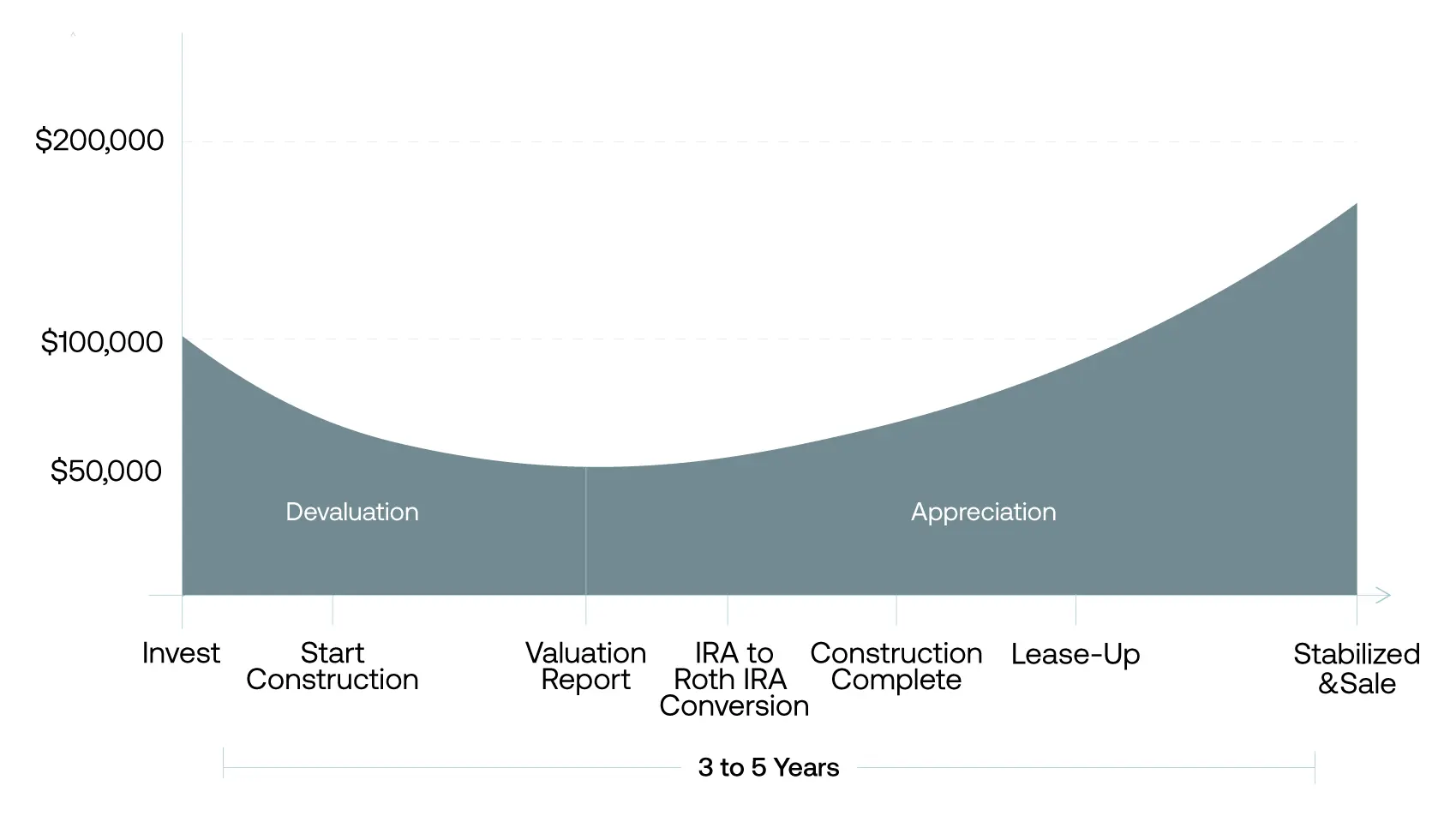
Commercial real estate development often follows what Tim Witt describes as a J-curve.
After an investor contributes capital, that money is gradually deployed into expenses such as:
During this period, much of the original cash may have been spent while the property remains incomplete.
An unfinished development can have fewer potential buyers than a stabilized property. An ownership interest in an LLC or limited partnership may also be affected by factors such as illiquidity and lack of control.
Together, those factors may result in an independently appraised value below the investor’s original contribution.
Consider the simplified example discussed in the podcast.
An investor places $100,000 of traditional IRA assets into a development investment. During construction, an independent appraisal values that interest at $60,000 or $70,000.
If the investor converts the investment to a Roth IRA at that point, the taxable conversion may be based on the lower independently determined value.
The strategy does not eliminate the conversion tax. Instead, it potentially changes the value on which the conversion tax is calculated.
If the project is subsequently completed, stabilized and appreciates, that potential future value creation would occur after the investment has moved into the Roth structure.
Independent valuation is central to the process described by Witt.
Peachtree does not internally select the lower value used for a conversion. Instead, an independent third-party appraiser evaluates the investment and determines an updated value.
The appraisal may consider factors including:
The purpose is to establish a defensible assessment of the investment’s value at that stage of development rather than apply an arbitrary discount.
1. A Roth conversion is primarily a question of tax timing.
You generally recognize taxable income when traditional IRA assets are converted, in exchange for moving those assets into a structure where qualified future distributions can generally be tax-free.
2. Development can create a distinct valuation window.
An incomplete and illiquid development investment may temporarily appraise below its original value, potentially affecting the amount subject to conversion tax.
3. The investment still has to work on its own merits.
A lower appraisal does not make an unsuccessful project successful. Financing, construction execution, market demand, diversification and potential value creation remain essential investment considerations.
A Roth conversion involving commercial real estate brings together tax planning, valuation and investment risk. Any conversion decision should be considered in the context of an investor’s individual circumstances and reviewed with a qualified CPA or tax adviser.
Listen to the full episode of Peachtree Point of View to hear Greg Friedman, Tim Witt and Victor LeBlanc discuss Roth IRA conversions, development valuations, diversification and the investment considerations behind the strategy.

.webp)
Opportunity Zones are entering their second phase. Starting in 2027, the program becomes permanent, capital gains get a rolling five-year deferral instead of a fixed deadline, and rural investments qualify for a larger basis step-up. Zones will also be redesignated every 10 years going forward. These changes make Opportunity Zones easier to fold into long-term investment planning, but they don't change the importance of underwriting the investment itself.
Opportunity Zones will look materially different beginning in 2027. The key changes are summarized below.
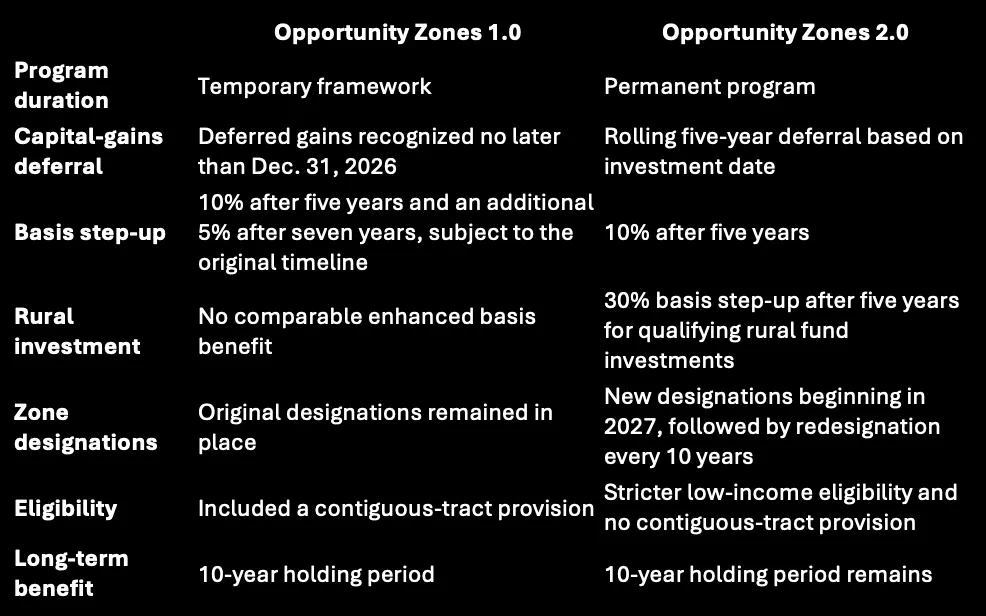
The first new round of Opportunity Zone designations takes effect January 1, 2027, beginning a recurring 10-year redesignation cycle. For investors evaluating Opportunity Zones ahead of 2027, five questions stand out.
OZ 2.0 replaces the program-wide 2026 recognition deadline with a five-year deferral period for qualifying investments made beginning in 2027. Deferred gains are generally recognized five years after the investment, unless an earlier inclusion event occurs.
Under OZ 1.0, deferred gains generally had to be recognized by December 31, 2026, regardless of when the investment was made, making the benefit progressively less valuable as the deadline approached.
Under OZ 2.0, each qualifying investment effectively receives its own five-year clock. Will Woodworth, senior vice president of investments at Peachtree Group, expects the change to allow better tax planning and support “more consistent cash flows into the space.”
Investors who hold a qualifying OZ 2.0 investment for at least five years receive a 10% basis step-up, while investments in a Qualified Rural Opportunity Fund (QROF) receive a 30% step-up after five years.
Under OZ 1.0, investors could receive a 10% increase after five years and another 5% after seven years, although the program’s fixed timeline limited those benefits for later investments.
OZ 2.0 also reduces the substantial-improvement threshold for property located entirely within qualifying rural Opportunity Zones from 100% to 50%. These incentives could make some rural projects more viable, but investors still need to independently underwrite demand, liquidity, financing and exit risk.
Yes. OZ 2.0 makes Opportunity Zones a permanent part of the tax code, with qualifying areas refreshed every 10 years.
Under OZ 1.0, investors faced an eventual program expiration and a fixed 2026 recognition date. Permanence allows investors, developers and capital allocators to evaluate Opportunity Zones as a long-term investment framework rather than an incentive approaching expiration.
As Woodworth put it, permanence makes Opportunity Zones an actionable strategy “not just right now, but for decades into the future.”
Yes. Under OZ 2.0, Opportunity Zones will be redesignated every 10 years, with the first new round taking effect in 2027. That differs from OZ 1.0, where the original map was essentially static.
Eligibility also becomes more targeted, with the qualifying median-family-income threshold declining from 80% to 70% and the contiguous-tract provision eliminated.
As a result, markets that qualified under OZ 1.0 may not qualify under OZ 2.0, while new eligible areas will emerge.
No. Investors generally still need to hold a qualifying Opportunity Zone investment for at least 10 years to access the program’s principal long-term tax benefit.
That remains an important consideration for real estate investors because a decade can span multiple property and credit cycles. Financing, valuations, supply and demand, and liquidity may look very different at exit than at acquisition.
The improved tax framework therefore does not change the importance of investment fundamentals, including basis, leverage, refinancing assumptions and sponsor execution.
OZ 2.0 also introduces a new 30-year rule worth noting. Under OZ 1.0, an investor only received the step-up to fair market value by selling the investment after the 10-year mark. Under OZ 2.0, that step-up to fair market value happens automatically at the 30-year point, regardless of whether the investor has sold.
Investors should first ask whether the underlying investment is attractive without the Opportunity Zone tax benefits.
The 2027 relaunch makes Opportunity Zones easier to evaluate as part of ongoing capital allocation rather than as a deadline-driven tax strategy. But the fundamental question remains:
Would this be an attractive investment without the tax benefit?
If the answer is no, a better Opportunity Zone structure may not change it. If the real estate, basis and capital structure are compelling, however, OZ 2.0 provides a more predictable framework for evaluating the after-tax return across multiple investment and real estate cycles.
This article is for informational purposes only and does not constitute tax, legal or investment advice.

Peachtree Group, a vertically integrated private investment firm active in commercial real estate, private credit and hospitality, today announced it has been named to the 2026 Inc. 5000, marking the firm’s fourth consecutive year on the magazine’s annual ranking of the fastest-growing private companies in the United States. Peachtree ranked 3,831 on this year’s list, with three-year revenue growth of approximately 67%.
Sustaining that pace is rare. Research from Stanford Graduate School of Business and IESE Business School found that only about 30% of companies on high-growth rankings return the following year, implying that roughly 3% would be expected to appear four successive years.
For Peachtree, the growth behind the ranking has also meant a larger team and a wider set of career paths. The firm has grown to over 3,700 employees across its investment, lending, development and hospitality businesses, with approximately 10% of open roles filled internally over the past year.
“We’re grateful for the recognition, but what I’m most proud of is the ecosystem behind it,” said Greg Friedman, managing principal and CEO of Peachtree. “We’ve built a place where someone can start in one division and build an entire career here, moving from real estate into credit, from underwriting into hotel operations, from analyst to principal, without ever having to leave. Growth on a list is a byproduct. Advancement in people’s careers is the point, and it’s the reason we’ve been able to maintain our expansion through different market environments.”
The recognition follows another milestone for the firm. Earlier this year, Peachtree was named to the inaugural PERE Credit 100, ranking among the world’s leading commercial real estate private credit managers. The annual ranking measures firms based on institutional capital raised for private real estate credit strategies over the previous five years.
“Together, these recognitions tell a consistent story,” Friedman added. “The Inc. 5000 acknowledges our ability to scale a high-growth business over time, and the PERE Credit 100 reflects the institutional platform we’ve built in commercial real estate credit. Both recognitions reveal the same foundation, a team that has earned the confidence of our investors and our partners.”
As investors increasingly seek tax-efficient strategies to preserve wealth and generate passive income, Peachtree Group ("Peachtree"), a leading commercial real estate investment firm, has expanded its Delaware Statutory Trust (DST) platform with two new acquisitions that provide accredited investors access to institutional-quality commercial real estate through 1031 exchange-eligible investment opportunities.
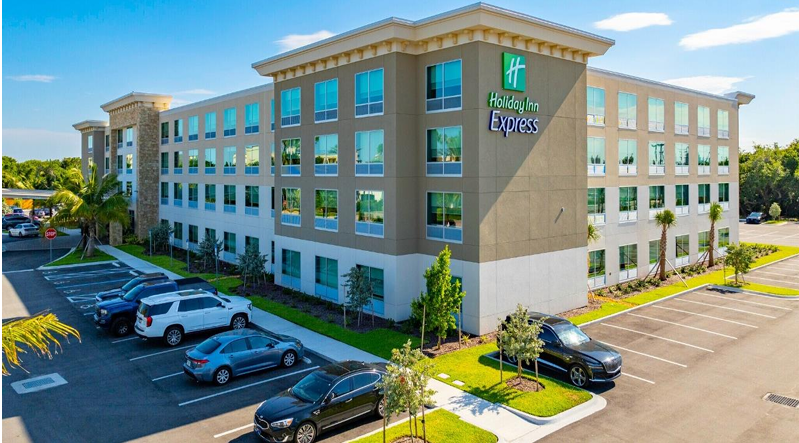
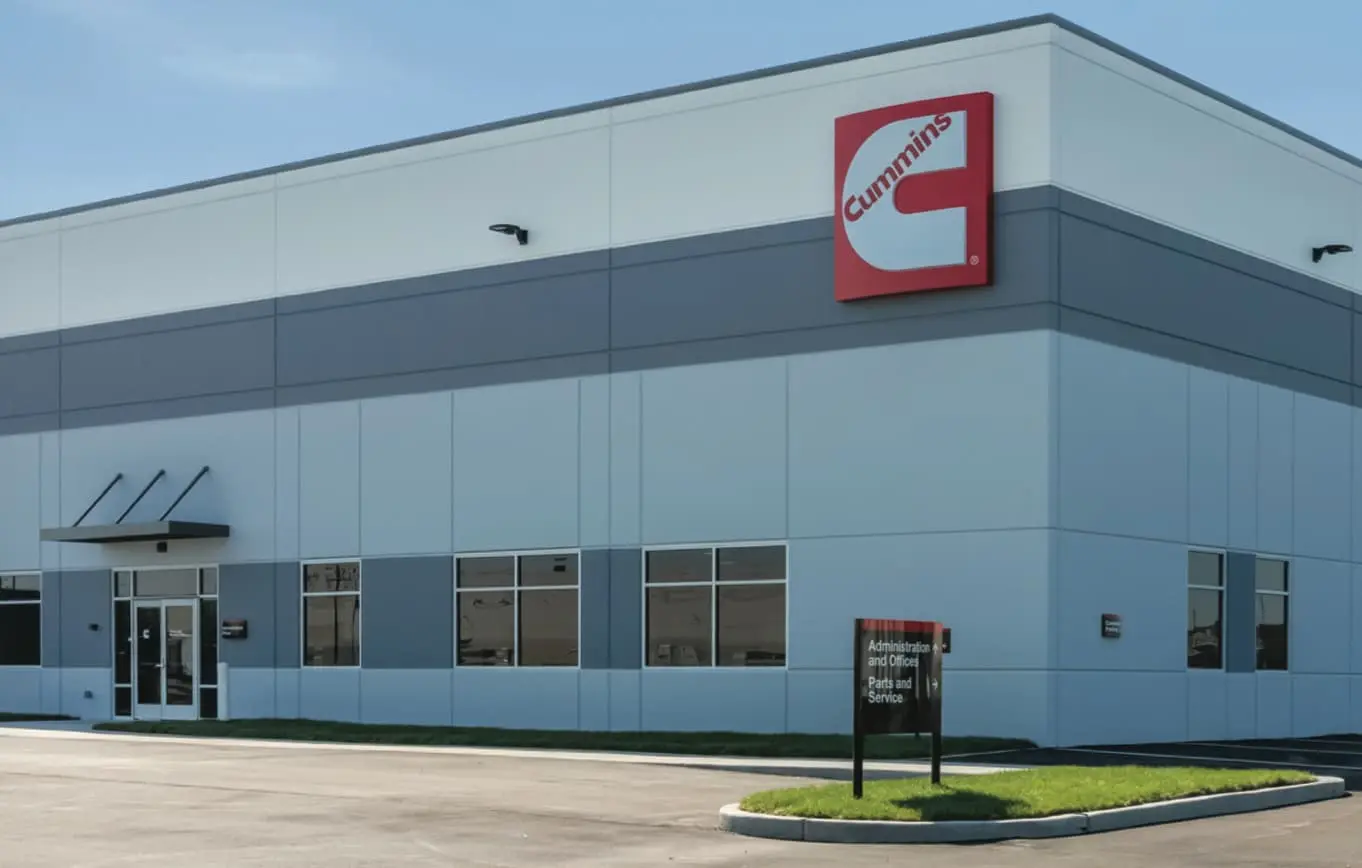
The expansion includes PG Cape Canaveral DST, anchored by the Holiday Inn Express Cape Canaveral in Florida, and PG St. Louis Industrial DST, a newly constructed Class A industrial facility in the St. Louis metropolitan area leased to Cummins Inc.
The acquisitions mark Peachtree's 14th and 15th DST offerings, bringing the total value of the firm's DST offerings to approximately $525 million since launching the platform in 2022. According to Mountain Dell Consulting, Peachtree currently ranks as the No. 7 most active 1031 exchange sponsor based on year-to-date 2026 capital raise activity.
"Our investors are looking for more than tax efficiency. They want access to high-quality real estate with durable income potential and professional management," said Greg Friedman, managing principal and CEO of Peachtree. "Our DST platform has been built to deliver institutional-quality investments across sectors where we have deep operating and investment expertise, giving investors access to opportunities that are often difficult to source on their own."
PG Cape Canaveral DST is anchored by the 150-room Holiday Inn Express Cape Canaveral, a recently developed hotel located directly across from Port Canaveral, the world's busiest cruise port. The property benefits from diversified demand generated by Port Canaveral, Kennedy Space Center, Cape Canaveral Space Force Station and Florida's Space Coast leisure destinations, creating multiple sources of lodging demand throughout the year.
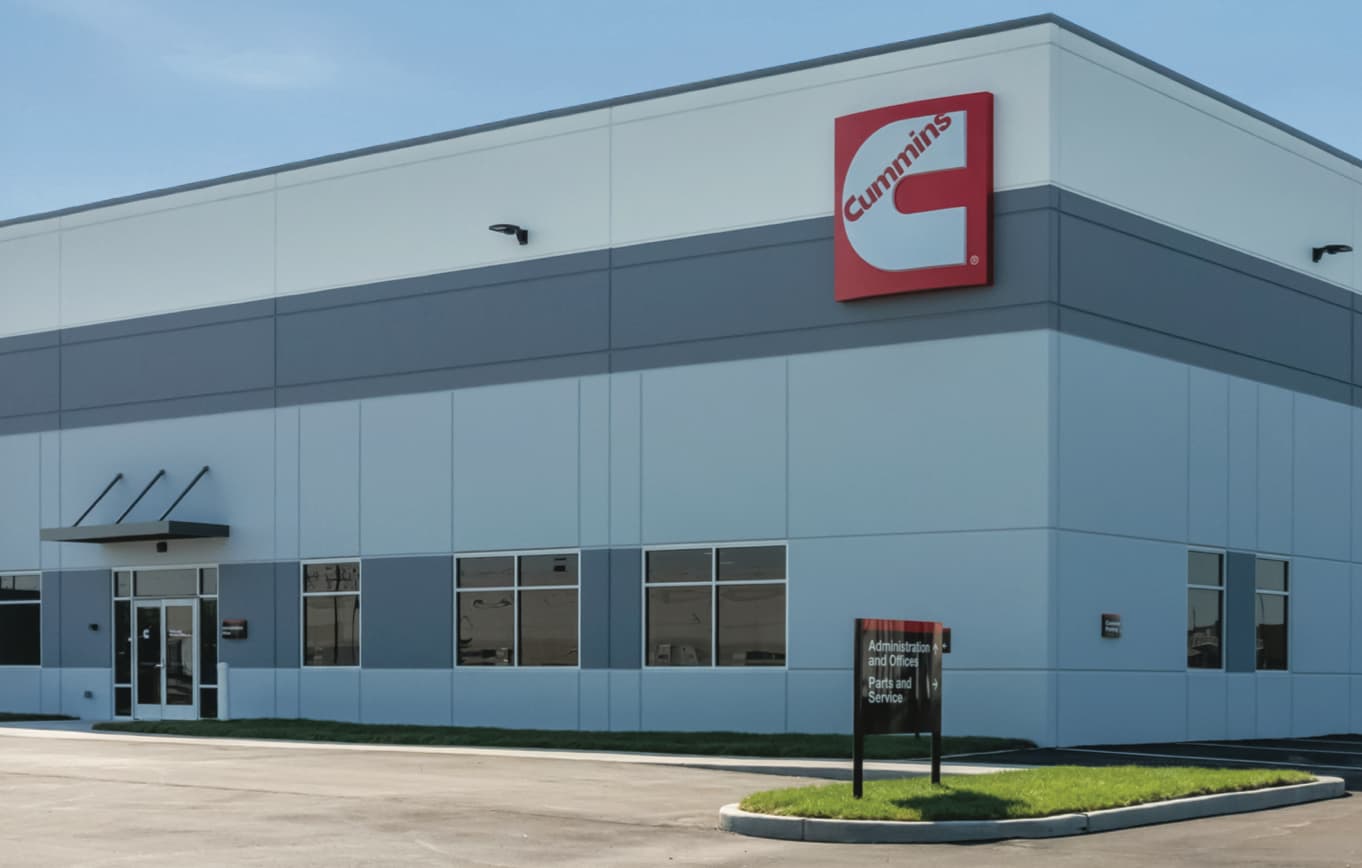
PG St. Louis Industrial DST consists of a newly constructed 48,206-square-foot Class A industrial sales and service facility in the St. Louis metropolitan area. The property is 100% leased under a 15-year net lease to Cummins Inc., an investment-grade global power solutions company. Located within Gateway Commerce Center, one of the nation's premier industrial parks, the asset offers stable cash flow supported by long-term corporate tenancy and contractual annual rent increases.
"We continue to expand our DST platform with investments that meet the same underwriting standards we apply across our broader real estate business," said Tim Witt, president of 1031 Exchange and DST Products at Peachtree. "By maintaining a disciplined approach to asset selection across multiple property sectors, we're building a broader pipeline of institutional-quality opportunities that help investors achieve their long-term investment objectives."
